
Safety & Security
Safety Tips
PATCO is interested in your safety. It’s our foremost concern. As a PATCO transit passenger, you are using one of the safest modes of transportation available today. You can contribute to your safety and the safety of others with these tips:
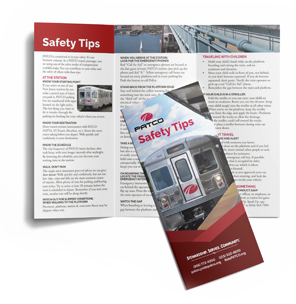
 PATCO Safety Tips Brochure
At the Station
-
Know your starting point
If you arrive at one of our New Jersey stations by car, make a mental note of where you park it. PATCO parking lots are numbered with signs located on the light poles. The last thing you want to do is wander through the parking lot looking for your vehicle when you return. -
Know your destination
Many transit systems interconnect with PATCO (SEPTA, NJ Transit, Riverline, Amtrak, etc.). Know the route you’re taking before you depart. Walk quickly and confidently to your destination. -
Know the schedule
The trip frequency of PATCO trains declines after rush hour, with even longer intervals after midnight. By knowing the schedule, you can decrease your waiting time in the station. -
Walk, don’t run
Slow down! Walk quickly and confidently, but not too fast: slips, trips and falls are the most common causes of injuries. Allow plenty of time for parking and buying your ticket. Try to arrive at least 10 minutes before the train is scheduled to depart. Remember, if you miss your train, another one will be along shortly. -
Watch out for slippery conditions when walking to the platform
Pavement may be slippery when wet. -
When you arrive at the station, look for the emergency phones
Red “Call for Aid” or emergency phones are located at the fare gates of every PATCO station, just pick up the phone and dial “0.” Yellow emergency call boxes are located on every platform and in every parking lot. Push the button to call Police. -
Stand back from the platform edge
Stay well behind the yellow warning line. If you drop something into the track area, do not try to retrieve it; the “third rail” of the tracks conducts high and fatal electrical voltage. Use the red “Call for Aid” phone at the fare gates to contact a PATCO employee who will retrieve your item for you.
On Board the Train
-
Use the buddy system
If at all possible, travel with another person. There really is safety in numbers. If that’s not an option, ride in the first car, close to the train operator, especially at night or during other times of low ridership. -
Take a seat whenever one is available
Sitting not only protects you from potential falls, but also is a courteous way to allow other passengers to easily access the vestibule doors. If you must stand, hold onto a seatback or pole. Trains will lurch unexpectedly. Holding on helps prevent a fall and keeps you out of your fellow passenger’s lap! -
On boarding the train, locate the passenger emergency intercoms
Emergency intercoms are located in every car behind the operator console near the flip up seats. Press the red button to notify the train operator of an emergency. -
Watch the gap
When boarding or leaving a train, be aware of the small gap between the platform and the train.
Traveling With Children
-
Take children by the hand
- Hold your child’s hand when boarding and exiting the train, and on escalators and elevators.
- Have your child walk in front of you, not behind, so you don’t become separated. If you do become separated, don’t panic. Notify the train operator or pick up a red “Call for Aid” phone.
- Remember the gap between the train and platform.
-
If your child is in a stroller:
- Fold the stroller so you can carry your child on stairs or escalators. Better yet, use the elevator. Strap your child snugly into the stroller at all other times.
- When you’re on the platform, keep the stroller away from the edge and apply the brake. Platforms tilt toward the tracks to allow for drainage, and the stroller could roll toward the tracks.
- Never place a stroller between closing train car or elevator doors.
Late Night Travel
-
Remain awake and alert
- If at all possible, travel with someone you know.
- Don’t stand alone on the platform.
- If you feel uncomfortable, move toward other people or seek a PATCO employee for assistance.
- Ride in a rail car that is occupied by other people, or in the first car (if available), which is where the train operator is located.
- Have your keys ready as you approach your car, always look inside before entering, and lock the doors as soon as you get inside your vehicle.
See Something, Say Something
-
Report objectionable conduct ASAP
- Tell a train operator, police officer, or employee, or use the red “Call for Aid” phone at station fare gates
- Use our "Look Up. Speak Up." app to report anything suspicious. Tips are completely anonymous, and they're accepted and responded to around the clock, all year round. Learn more.
- DRPA Police is available 24/7 at (856) 963-7995
|


